Japan Open to Two More Integrated Resorts
Japan has announced that applications for new casino resorts (integrated resorts) will be accepted starting May 2027.
Round 1A – First IR Approved
In July 2018, the Japanese government approved a bill to legalize casinos in the country and set up an application process for up to three IRs in Japan under the Integrated Resort Development Act. The framework and timeline of the process were relatively clear, with Prefectural governments receiving bids from operators and developers, with an initial application window from October 2021 to April 2022. The National government then had the final say on licensure.
However, the rules and regulations were slow to develop, and then the macroeconomic shock from the pandemic scared off many would-be bidders, financiers, and prefectural governments. As a result, few applications actually moved forward to the national government. In the end, only the MGM/Orix IR bid in Osaka Prefecture received final approval for development of an integrated resort. It is currently expected to open in 2030.
Round 1B – Two More IRs Possible
That still left two licenses that could be awarded, and now a new application window has been opened, with applications due to the national government between May and November 2027. Several prefectures also seem more willing to participate than they were during the initial licensing process.
The Osaka IR will have a clear first-mover advantage, as it is doubtful that a second IR could open sooner. But second movers will also have an opportunity to benefit from being able to observe Japanese gaming propensity, behavior, and preferences, as demonstrated at the MGM IR, along with the implications of the nuances of Japanese gaming regulations. That could lead to savings that might otherwise be lost to trial and error on game mix and floor layout decisions. As such, it is possible that gaming companies that did not bid in the first round may now decide to participate.
For gaming companies looking to enter the Asian gaming market, or expand their presence in it, there is also the obvious question of what the alternatives are. Thailand appears off the table again for the foreseeable future. The Philippines is getting well saturated. Major operators have thus far stayed away from Vietnam. Foreigner-only casinos in Korea have not yielded great results yet, and there likely will not be any new opportunities in Macau anytime soon. So that leaves Japan: a potentially sizable gaming market for an operator of any scale, and certainly a place worth kicking a few tires.
The questions now are how many applications, if any, will make it to the final nationwide selection process in 2027, and where. Another important question is which companies are going to pursue these bids, but so far that has remained relatively quiet.
Potential Locations
The list of prefectures that could submit an application in 2027 is not all that different from what it was in 2018, though the odds have shifted a bit. As yet, there have not been signs of momentum at the government level for bringing a license to Tokyo or Yokohama. But, as was the case in 2018, if that changes, the largest operators in the world may again show interest.
That still leaves several prefectures that could pursue what had been referred to as “regional IRs,” at a significantly lower development cost than the Osaka IR, but still with market potential well over $1 billion.
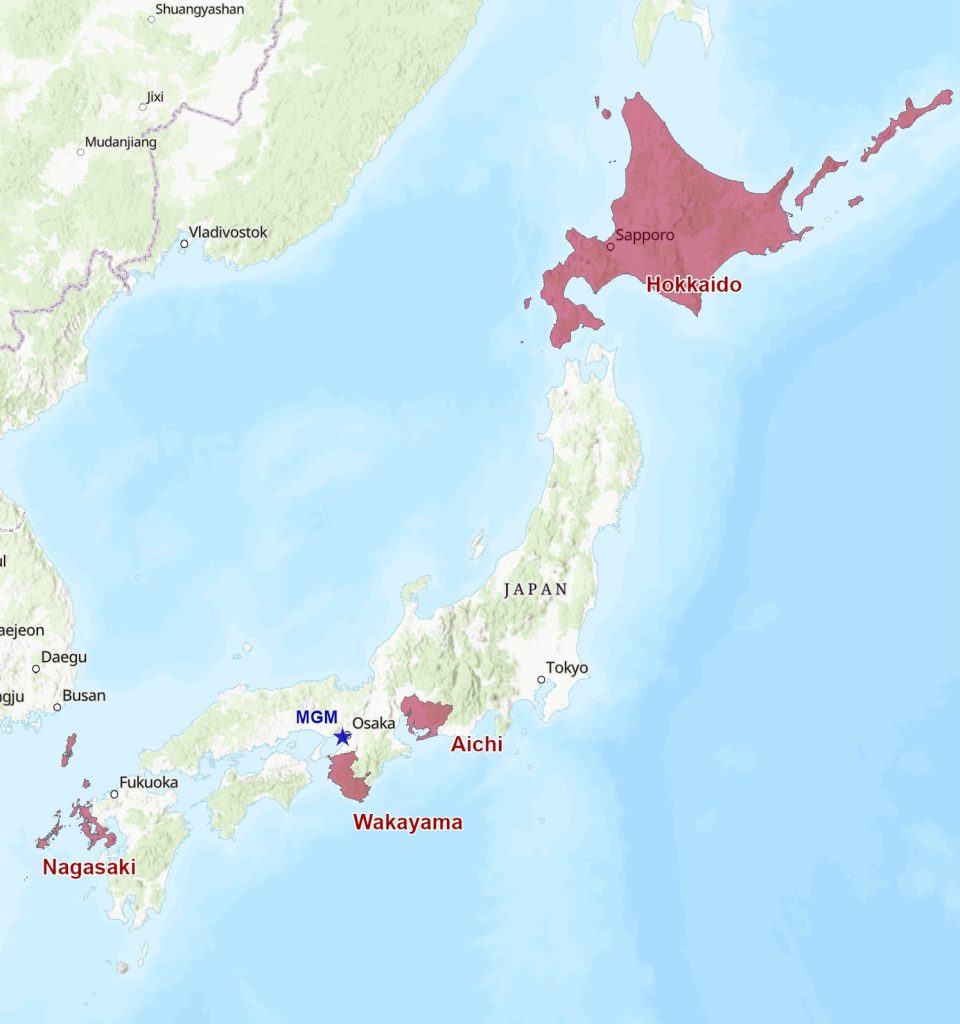
In the initial wave of applications, neither Hokkaido Prefecture nor Aichi Prefecture submitted bids, but sites had potentially been identified for development in both. Both prefectures are now undergoing feasibility studies to better understand market potential and the socioeconomic implications of development, and therefore appear more likely to submit applications during the 2027 window.
Hokkaido
Several companies looked at Hokkaido during the first application window, with a site in Tomakomai, near Sapporo, identified for potential development. Hokkaido is a popular winter tourist destination, but the prefecture is also well separated from any other major urban center in Japan. While that is a positive in terms of limited competitive threats, it also means relying on a relatively small prefectural population and dealing with seasonality in tourist visitation.
The factor that derailed things at the time was ultimately not the concept, but the location. The Tomakomai site raised environmental concerns related to protected wildlife, and there was not enough time to complete a full environmental impact assessment before applications were due.
The Hokkaido government is now conducting feasibility analyses for the upcoming application window, opening up bidding possibilities to towns throughout the prefecture. In addition to ongoing interest in Tomakomai, there is interest from the city of Kushiro for a site on Lake Akan, though that too may face environmental challenges.
Assuming the feasibility analyses come back positive, and assuming environmental issues are either unfounded or can be adequately addressed, it would be reasonable to expect the prefecture to submit an application for one of the two sites. The market potential should be attractive enough for mid- to large-scale gaming operators.
Aichi
The Aichi Prefectural Government is evaluating the feasibility of IR development at a site adjacent to Chubu Centrair Airport in the city of Tokoname, approximately a 40-minute train ride south of the prefectural capital of Nagoya. Chubu Centrair is one of the busiest airports in Japan, providing strong access to major international feeder markets, much like Osaka and Tokyo.
Aichi’s decision to wait during the first application window may have been prudent, as the planned completion of maglev train connectivity to Tokyo and Osaka has been delayed from an initial estimate of 2027. Operations are now not expected until at least 2035 to Tokyo and 2037 to Osaka. When completed, though, travel times to Tokyo will be just 40 minutes, and 67 minutes to Osaka, effectively making a large swath of the country a potential day-trip market.
But there are also some downsides. The airport is approximately 40 minutes south of Nagoya, which is not much of a tourist attraction in its own right, and there are no major tourist draws near the airport or obvious reasons for a tourist to want to stay proximate to it. Additionally, the site identified for development, assuming it is the same parcel previously considered, is somewhat restrictive in shape and scale from a design standpoint, especially given likely height restrictions at an airport-adjacent site.
Assuming the results of the feasibility study are supportive, and given that much of the infrastructure is already in place, an IR could potentially be developed relatively quickly here and ultimately serve a sizable domestic and international patron base. The major downside is that the maglev is likely a key driver of feasibility, and it may not be operational for the first several years of the project’s life. A better candidate for the third application window?
Nagasaki
Will Nagasaki Prefecture get another bid to submit?
Several companies looked at Nagasaki/Fukuoka in the late 2010s, with a bid ultimately rejected by the national government due to financing issues. One benefit to a casino in this region is that its southern location conceivably makes it one of the easiest places in Japan to reach from China, Taiwan, and Korea. However, the nearest international airport was still more than 30 minutes from proposed casino sites, making accessibility less than ideal. As with Hokkaido, the regional population base is also relatively small, meaning an IR here would likely need to be at more of a regional casino scale.
Wakayama
Will Wakayama Prefecture continue to be considered?
An IR plan during the 2021/2022 application period fell apart at the Prefectural level due to concerns about project financing. That project, however, was ambitious in scale and could have served a sizable market. The major downside is/was that Wakayama abuts the only other Prefecture that was getting an IR (Osaka), and therefore there is potentially significant overlap. As a result, if there are multiple bids nationwide in the 2027 rounds of applications, it could work against them.
Revenue Potential?
Between 2017 and 2023, we conducted evaluations of the gaming market potential for these various prefectures, and in our view the revenue potential was strong enough for mid- and large-scale operators to at least contemplate a bid. That said, development and operating costs in Japan are probably as high as they would be anywhere in Asia, which could dampen optimism that the country will actually attract two strong bids in this next round.
Author’s Note: Convergence Strategy Group Co-Founder, Scott Fisher has been actively involved in the Asian gaming space for nearly three decades, evaluating opportunities, right-sizing projects, and providing professional support which has resulted in some of the largest and most successful gaming developments in the world.
Other blog posts from Dr. Fisher include: Japan’s Integrated Resort Market Reopens?, Chinese Tourist Return and the Future of Asian Casinos, Progress Toward Integrated Resorts in Japan, Chinese Gamers – A Commodity Hit by the Trade War?, No New Casinos in The Philippines?, Integrated Resorts in Japan: When, Where, and How Much?, Coming Full Circle: Japan Gaming Congress 2018